
Art is Overvalued

Note: I wrote this piece back in 2020, and have included minor revisions. Fortunately, I think that art museums have made significant progress in terms of presenting more diverse and inclusive collections and exhibitions in recent years. Also, my view of Marcel Duchamp’s “Fountain” has improved considerably, for reasons that I may discuss in a later post.
The term “work of art” contains a basic tension. Work is common, but art is supposed to be special. For example, countless beautiful ceramics have been produced at factories: are they art, or consumer products? This post favors the latter interpretation, and argues that it could help to accelerate the diversification of museum collections.
A. Art is Overvalued
1. Excellent Art is Common
If you have just one day to spend at a museum on Amtrak’s Northeast corridor, I recommend the MET in New York City, or the MFA in Boston. Both places are big, encyclopedic institutions which offer visitors the chance to transport themselves to a wide range of geographies, chronologies, and cultures. However, even a full day of focused, substantive engagement can encompass only a small portion of their on-view collections and exhibitions, let alone the stuff in storage (I’m also very fond of Philadelphia’s Museum of Art, but it doesn’t have the same cultural range as its more northward peers).
Below are some of the highlights from a series of visits to the MET in October 2020 (1, 2, 3, 4).
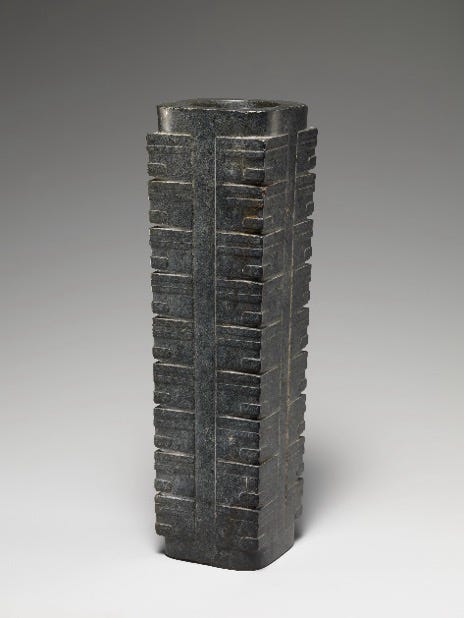
Neolithic jade cong, China, around 2400 BCE
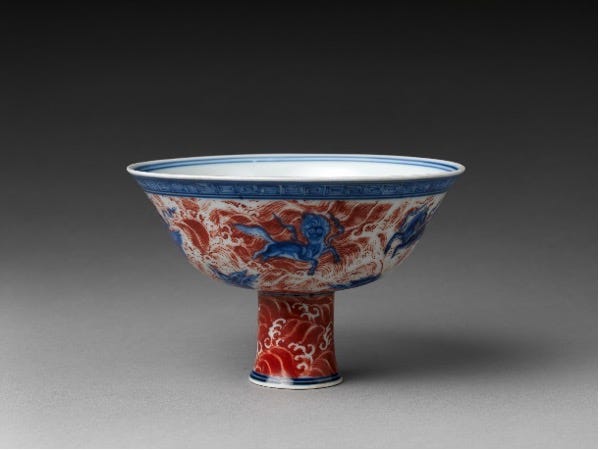
Ming Dynasty, Altar Bowl, mid 15th Century

Dogon peoples (Mali), Equestrian Figure, 16th-18th Century
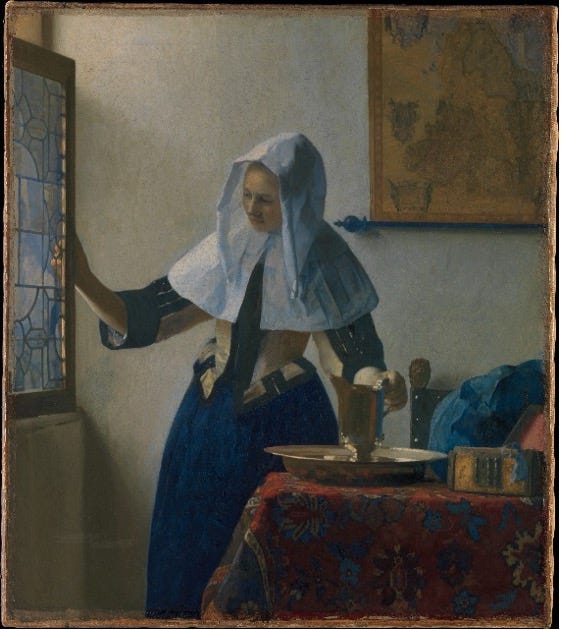
Johannes Vermeer, Young Woman with a Water Pitcher, around 1662
From one perspective, each of these works is a true masterpiece. In person at least, they are sublime; physical manifestations of top-flight creativity. From another point of view, however, they’re a little blasé; the MET, after all, is full of high caliber stuff, and it’s an enormous place. Additionally, there are lots of good museums in the Mid-Atlantic/Northeast region. For example, The Clark in Western Massachusetts has a small, but lovely collection of items from the Sevres Porcelain Manufactory.
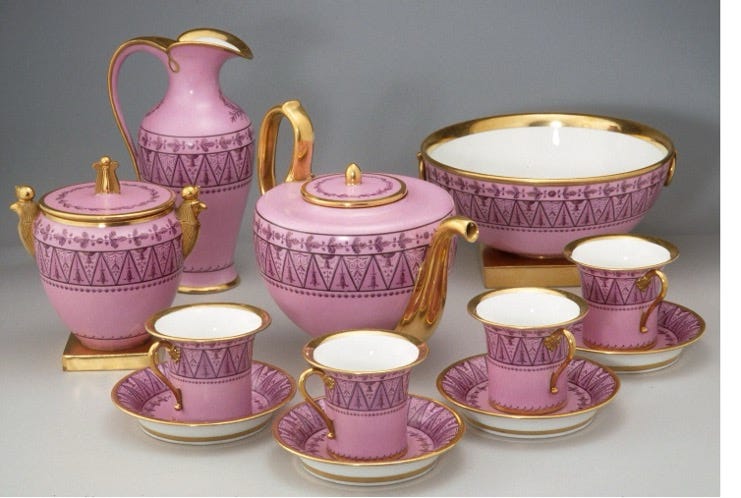
Sèvres Porcelain Manufactory, Tea Service, 1812, Hard-paste porcelain. The Clark Art Institute, 1955.1306.1-16a-b.
Now this tea service certainly isn’t a masterpiece, but it is quite beautiful, and it illustrates the abundance of visually appealing objects from across the globe that are open to museum visitors.
The next two examples are from the Smithsonian’s museums of African and Asian art; relatively small institutions with high quality collections (1, 2).

Inland Niger Delta region (Mali), Equestrian Figure, 13th-15th century

Katsushika Hokusai, Dragon, Edo period (1615 - 1868)
Basically, if you spend enough time in these places, both art, and the artists who make it, become increasingly ordinary. Talented, to be sure, sometimes superbly so, but still fairly common.
2. For non-billionaires, the best art is dramatically overpriced
Among my favorite art works are wall sized drip paintings by Jackson Pollock. I have spent a considerable amount of time staring at them at the MOMA, the National Gallery, and, to a lesser extent, the MET. In my experience, the best scenario for viewing one of them has three components: a peaceful state of mind, a decent viewing position, and a successful effort to unfocus your eyes while looking at the canvas. In this mode of viewing, the colors are more striking, the contrasts sharper, and the whole thing has a shadowy, archipelagic look to it. Don’t ask me why I find this experience to be so absorbing, but I do, and I am hardly alone. According to Business Insider, two of Pollock’s drip paintings are among the most expensive ever sold: one for $140 million, the other for $200.
From a financial investment perspective, these prices might make sense - I don’t know - but as far as the value of an individual experience is concerned, the numbers are crazy. Bless Pollock, but the psychic pleasure that I derive from looking at his paintings isn’t close to the pleasure I would feel from having a huge amount of money in the bank - we’re talking about many lifetimes of luxury, and nearly unbridled freedom here. More concretely, the idea of paying that kind of money for a paint splattered strip of canvass is clearly insane, no matter how appealing and interesting the splatter happens to be. And, of course, it’s not just Pollock. According to Artnet, the most expensive painting sold at auction in 2020 was an $84 million work by Francis Bacon called “Triptych Inspired by the Oresteia of Aeschylus.” I freely admit that the handful of paintings that I’ve seen by Bacon don’t particularly appeal to me, so maybe I’m missing something, but I don’t think I’m missing $84 million worth of somethings.
Notably, however, the average auction price last year was far lower, just $35,698. This much more reasonable number suggests that the overall art market is not egregiously overpriced. Similarly, when I perused the local Artwalk in Lennox, MA last year, I thought the prices were reasonable, though certainly not cheap.
Overall, my point is not be dismissive of the value of art, but to argue that while museums are purveyors of wonderful cultural products, they are not repositories of priceless cultural treasures. Well, actually, maybe they are in the sense that the value of a quality artwork is directly connected to the number of people who are able to meaningfully engage with it. Put a great painting on a yacht, and its value plummets; put it in a public museum for several centuries, and maybe it will earn its hundred million dollar valuation.
3. Modern and contemporary art ideas favor the productification of cultural output
In 1917, Marcel Duchamp signed a urinal with the initials R. Mutt. By doing so, he transformed a bathroom fixture into a work of art; and, by implication, he argued that toilet factories were as much centers of cultural production as Jingdezhen in China, or Sevres in France. The original version has been lost, but I saw a replica of the grandiosely named “Fountain” – it’s not even a bidet - in Philadelphia.
Now, strictly speaking, Duchamp wasn’t saying that all urinals are art works. The key point, supposedly, is that he changed the cultural context of the object by adding a signature and proposing that it belonged in an art gallery. By doing so, he turned an industrial product into a readymade: “A term coined by Marcel Duchamp in 1916 to describe prefabricated, often mass-produced objects isolated from their intended use and elevated to the status of art by the artist choosing and designating them as such. The term “assisted Readymade” refers to works of this type whose components have been combined or modified by the artist.”
According to this definition, artists are alchemists who can convert ordinary things into museum worthy objects with minimal alterations. Personally, I think this a bit much; adding a signature, and putting it in a museum, does nothing to change the fact that I’m looking at a pisser. There are plenty of graffitied urinals in the world, and, as far as I can tell, there are only two reasons why the “Fountain” is considered interesting. First, because it was created by an “artist,” as opposed to a random high school student with a sharpie. Second, because it is presented by museums and galleries full of art professionals, as opposed to the janitorial staff of a local elementary school. To be clear, I have absolutely nothing against cultural professionals – indeed, as someone who loves visiting museums, they make an important contribution to my life – but when a bunch of artists, curators, and critics claim that the meaning of a run of the mill object is fundamentally transformed when an artist touches it, and a museum or gallery presents it to the public as “art”, I can’t shake the feeling that they’re selling something. In this case, I think the object on the auction block is the idea that the cultural elite – however one wants to define that – has distinctive social insight that makes them important, and worth listening to. Relatedly, if Jerry Seinfeld’s Comedians in Cars Getting Coffee is any indication, it appears that stand-up comics have a similar group identity.
While I’m sure there’s a decent argument to be made for this perspective, I don’t buy it. In my view, Duchamp’s alteration to the urinal is not materially significant, and a person who takes the “Fountain” seriously from an aesthetic perspective should be equally excited to see an exhibition of American Standard’s latest lineup (actually, the Town Square Suite looks pretty nice). Now, to be reasonable, the real significance of the “Fountain” is not its material reality, but its symbolic meaning: it represents Duchamp’s decision to submit a toilet for entry in a serious art exhibition. However, one can appreciate the audacity of that act without ever seeing the thing itself - the story is what matters, not the object - in fact, after seeing the thing, one might reasonably wonder whether the audacity was worth it. Nevertheless, the urinal endures, and it is widely hailed as one of the most important artworks of the twentieth century.
My entirely non-sarcastic takeaway from all of this is that an appliance showroom at Best Buy could be transferred to a modern/contemporary art museum without much difficulty. Throw in the kind of highfalutin narratives that curators specialize in, plus a social justice friendly discussion about factory workers being skilled artisans, and the thing’s in the bag. To be clear, I would have little interest in seeing such an exhibition, but I do think it would be logically consistent with modern and contemporary ideas about art that are freed from cultural elitism. Moreover, while I’d rather not spend a nice Saturday afternoon staring at household appliances, I do think it is important to ask why the discussions about the “Fountain” are all about Duchamp and his friends, but not the factory workers who actually made it.
For purposes of this post, the central point is that the line between individual artistic output, and mass-produced commercial products, has become increasingly fuzzy. And just as mass production has driven down prices for consumer goods, it seems reasonable that the process should have a similar impact on art prices. Overall, while I don’t want to push this parallel too far, because I am aware of its limitations and exaggerations, I do think there is a kernel of truth here – the more that the ordinary becomes art, the harder it is to justify special cultural status for artworks.
4. Forgery, AI, and 3D Printing
In 2011, the Knoedler gallery in New York City closed down due to a major scandal involving Abstract Expressionist fakes by a talented forger. And in 2017, the Winterthur Museum in Delaware put on an exhibition called “Treasures on Trial: The Art and Science of Detecting Fakes” (I wish I had seen it). Presumably, forgeries only become scandals because, at some point, people were willing to pay serious money for the fakes, and then want their money back when the deception is revealed. So, for at least a brief moment in their existences, the copies of the masterpieces were mistaken for the originals; and, in those moments, they were great artworks. After all, an artwork isn’t an object, it’s a visual interaction between an object and a viewer; the human gaze gives cultural reality to paintings, rather like the Higgs field gives mass to electrons. Consequently, if you think you’re looking at a masterpiece, and if you have the positive experience of looking at a masterpiece, then, for all practical purposes, you are looking at a masterpiece.
And thus we have a question, which will not be answered here. How much of the value of art is wrapped up in a range of human emotions and ideas that have little to do with the ability of an object to spark a meaningful cultural connection? And, to be clear, I’m not being judgmental here; I’ve certainly had the experience of not thinking much of an artwork when I first looked at, only to develop a higher opinion of the piece when I learned that it was by a famous artist.
Nowadays, however, human forgery is increasingly quaint. The real future of art replication may lie with artificial intelligence and 3D printing. Consider these astonishing paragraphs from a 2018 Artnet piece:
Possible uses for the new technology include creating copies of famous works of art for home collectors, making postcards and prints of historical pieces, or even making facsimiles that could hang on museum walls to help better preserve fragile originals.
While it might seem a shame to lock away authentic works in lieu of showing the public a copy—however convincing it might be—the MIT team sees their new technology as making the best of a bad situation.
“The value of fine art has rapidly increased in recent years, so there’s an increased tendency for it to be locked up in warehouses away from the public eye,” said project mechanical engineer Mike Foshey in a statement. “We’re building the technology to reverse this trend, and to create inexpensive and accurate reproductions that can be enjoyed by all.”
If the technology becomes good enough to realize this vision, then the implications would be profound. Rather than being small quantity producers of custom objects, artists might be more like Apple, developing the visual arts equivalents of iMacs, iPods, and iPhones and then making money through mass production. In such a world, one can imagine artists becoming as legally protective of intellectual property as today’s pharmaceutical companies (the law firm Sheppard Mullin has a brief whitepaper on the IP dimensions of NFTs).
Personally, I think it would be a losing battle; regardless of laws and enforcement efforts, the black market for these copies would probably flourish. Also, since so much of the value of art lies in the in-person experience, it’s hard to imagine a visual arts equivalent to Spotify or Pandora which, at least in theory, help to counter such piracy by providing a legal, reasonably priced method for getting whatever music you want, whenever you want it. In practice, however, music piracy is still a problem, although I wasn’t able to find historical statistics comparing the industry costs of contemporary phenomena like stream ripping, to the Napster style piracy that was pervasive in my high school years (sadly, I wasn’t into music at the time, so I didn’t take advantage of the cultural bonanza). On a vaguely related, but still reasonably interesting note, iPhone knockoffs from China are getting significantly better, although it will still be a while before they are compelling substitutes.
Of course, the larger question with technologies like AI is whether today’s artists will be replaced by future robots. Some of the paintings in this AI gallery exhibition look pretty good, at least on the screen, and this demo video from the AI Painting Project is eye opening. Still, while I haven’t seen any of this stuff in person, it appears that robot artists won’t be taking over museum galleries anytime soon; additionally, there will probably be an enduring human preference to see works by other humans. However, the situation for more commercially oriented artists may be more precarious, and it’s not like the average artist is making a lot of money to begin with. According to the Bureau of Labor Statistics, the median annual pay for “Craft and Fine Artists” is $49,000.
Furthermore, it would be a mistake to pretend that high end human art-production may not be susceptible to dramatic technological disruption. Consider that sex robots, while still at a rudimentary stage of development, are sufficiently advanced for questions about consent, and concerns about rape and sexual slavery, to be socially relevant. Similarly, as digital technologies in general become more sophisticated, the implications for human intimacy could be profound - for some people, they already are. Although there’s a lot of speculation in this area, it seems reasonable to assume that if robots do transform core experiences like romance and physical intimacy, then the human-centered art museum will be a thing of the past. Put differently, if a good date can be automated, then good art will be a piece of cake.
So, to wrap up, while the above discussions of forgery and technological replication are clearly connected to the theme of art valuation - less scarcity should lead to lower value - I only included the last two paragraphs for the sake of subject matter completeness. Similarly, to conclude this section about art and technology, I recommend MOMA’s extremely high-quality 3D image of Van Gogh’s Starry Night. It’s not a substitute for seeing the painting in person, but it is a wonderful complement.
B. A less precious view of art could help to diversify American museum collections
While walking through Sonya Clark’s exhibition at the National Museum of Women in the Arts, and reading captions describing her views on race relations in America, it occurred to me that it is important to distinguish between talking about art as a product or commodity, and productifying or commoditizing the artists themselves. This delineation is particularly important when artists are from groups who have suffered violent, enduring, and pervasive oppression. Furthermore, during a period when artists from such groups are gaining greater prominence, arguments about art not being special may be unhelpful. Indeed, such an attitude could be perceived as an expression of majoritarian, status quo bias.
I’ll let readers make their own assessments on that point, and move on to why I think lowering the cultural and economic status of high caliber art will improve the museum ecosystem as a whole.
The main point is that if high art is viewed as being interchangeable, rather than irreplaceable, it will be easier for museums to swap out large numbers of works by well represented demographic groups, for pieces by dramatically under-represented groups. Along these lines, here’s my specific proposal.
Over the next decade - with clear, publicly verifiable annual milestones - museums should replace 1/3 of their on-view pieces by male, non-Hispanic White artists for works by artists from under-represented groups. Since museums are already facing deep organizational and financial challenges, this plan should not be pitched as a social pressure campaign, but rather as a nation-wide collaborative effort. It should be financed mainly through government funding, de-accessioning of works by male, non-Hispanic White artists and, ideally, substantial philanthropic support (Biden, Pelosi et al. are huge spenders, and this kind of program would be aligned with the left’s social justice agenda). If the idea ever gets off the ground, there would undoubtedly be a range of implementation challenges, which is why I think a decade timeframe is appropriate.
C. Conclusion
I love art museums. Relative to what they offer in terms of stimulating cultural experiences, the price of admission is cheap, and sometimes free. Moreover, the experience of being in these places is often wonderful, even apart from the quality of the art itself. However, I also think that the preciousness of high art can be an impediment to adaptation and flexibility. Fundamentally, a museum is an institution that needs to value the culture of the past, while being culturally relevant in the present: it’s a difficult job, and while much of this post has been critical, I want the closing to be positive.
Like so many institutions in American life, art museum collections are embarking on a much needed period of reformation; however, in carrying out these changes, the reformers should appreciate enduring strengths, while identifying and correcting long-standing weaknesses.